Automating your home with voice commands and automated schedules sounds appealing, but Indian homes present unique electrical realities that make standard international tutorials irrelevant.
Between older modular switchboard wiring without neutral conductors, distinct 6A versus 16A socket sizes, and strict rental tenancy agreements that forbid modifying wall switches, making the wrong choice leads to wasted money or unnecessary electrical hazards.
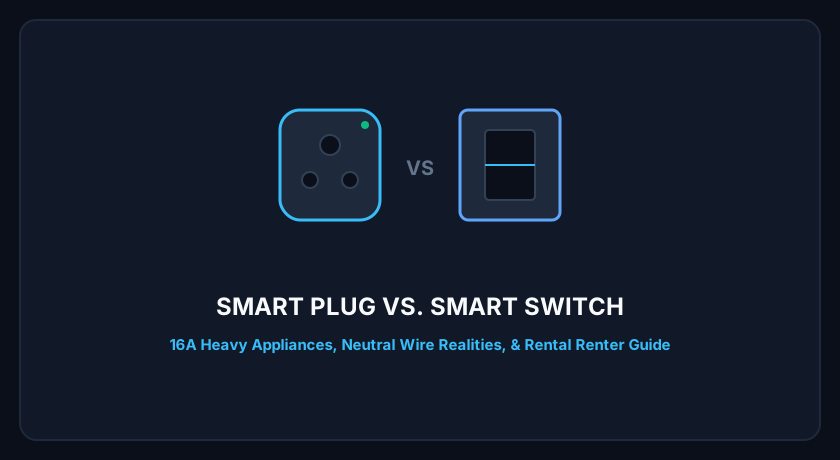
Here is a side-by-side comparison between Smart Plugs and In-Wall Smart Switches to help you determine the right path for your household.
What is a Smart Plug?
A smart plug is a self-contained adapter that plugs directly into any existing 3-pin wall socket. You plug your appliance (such as an air conditioner, geyser, or lamp) into the smart plug, connect it to your home 2.4 GHz Wi-Fi network, and control power via your smartphone or voice assistant.
Advantages of Smart Plugs:
- Zero Wiring or Electrician Required: Ready to use in under two minutes without opening any switchboards.
- 100% Tenant Friendly: If you live in a rented apartment, you can unplug the unit when moving out without leaving behind holes or altered electrical wiring.
- Built-in Power Monitoring: Most heavy-duty 16A smart plugs (like the Wipro 16A Smart Plug) feature real-time energy metering to measure exactly how many units of electricity your water heater or AC consumes each month.
Drawbacks of Smart Plugs:
- Form Factor Bulk: Plugs protrude 2 to 3 inches from the wall, which can prevent pushing beds or study desks flush against the wall.
- Physical Switch Confusion: If someone in your home manually turns off the master wall switch, the smart plug loses power and goes “offline” in Alexa or Google Home until switched back on.
What is an In-Wall Smart Switch Module?
An in-wall smart switch is a miniature relay module that an electrician installs behind your existing switchboard plates (such as Roma, Anchor, or Schneider). It wires directly behind your physical rocker switches, allowing you to control ceiling fans, concealed spotlights, and decorative chandeliers via both smart apps and manual physical buttons.
Advantages of In-Wall Smart Switches:
- Completely Invisible: Preserves your interior room aesthetics with zero bulky adapters protruding from walls.
- Retains Physical Switch Control: If an elderly relative or guest flips the manual wall switch, the smart relay state updates in the cloud while retaining instant manual control.
- Whole-Room Integration: One multi-channel relay module can automate four to six lights and a fan from a single switchboard box.
Drawbacks of In-Wall Smart Switches:
- Electrician Installation Required: Requires turning off the main MCB breaker and wiring behind high-voltage switchboards.
- Neutral Wire Dependency: In many Indian residential buildings, electricians historically did not pull a neutral wire into the switchboard box, making installation difficult without rewiring conduits.
- Tenant Restriction: Not practical for rented flats where landlords prohibit tampering with electrical wiring.
Direct Comparison Matrix
| Factor | Smart Plug (e.g. Wipro 16A) | In-Wall Smart Switch Module |
|---|---|---|
| Installation Ease | Plug & Play (DIY in 2 minutes) | Requires professional electrician |
| Rental / Tenant Friendly | Yes, 100% portable | No, permanent fixture |
| Heavy Appliances (AC, Geyser) | Ideal (look for 16A rating) | Requires heavy 25A/30A dedicated relay |
| Ceiling Fans & Inset Lights | Incompatible | Ideal solution |
| Energy Consumption Metering | Included on top models | Rarely available |
| Neutral Wire Requirement | Pre-wired in wall socket | Often missing in older boards |
Which Should You Choose?
- Choose a 16A Smart Plug if: You want to automate your morning bathroom water geyser schedule, track AC power consumption in summer, or live in a rented apartment where opening switchboards is out of the question.
- Choose an In-Wall Smart Switch if: You own your flat, have verified neutral wires inside your modular switchboards, and want seamless voice control over ceiling fans and concealed LED lighting without changing daily switch habits.
Editorial Note: Smartech Finds tests smart home devices on standard 230V, 50Hz Indian electrical supply. Read product manuals carefully before installation.